

What Your Body May Be Trying to Tell You
Cannabis, nutrient signals, and the quiet work of restoration, a gentle guide to feeling steadier, clearer, and more supported.
Some of the most important things the body communicates, it communicates quietly.
The body uses signals to let you know when something is starting to get off track. Some of us know this instinctively. We can often tell when a cold comes on before it fully arrives—a scratchy throat, unusual tiredness, that subtle sense that something is changing. We learn these signals over time. The same is true with many other signals: they show up early, often before anything feels serious.
This article is about what those signals might mean. The goal is to better understand what your body is telling you and how to support it well.
A Brief Way of Thinking About It
Think of your body as a neighborhood where everything has a job.
Magnesium helps run the electrical systems—supporting nerve and muscle communication. B vitamins run the energy production and help build neurotransmitters. Vitamin C and vitamin E handle oxidative repair. Zinc supports immune function. Vitamin D maintains the quieter infrastructure: bones, muscles, nerves, and immune balance.
When the neighborhood is well supplied, things run smoothly. When demand rises and supply falls—through stress, poor sleep, inconsistent eating, dehydration, or simple modern overload—the body starts sending small signals.
Symptoms are not a diagnosis. They’re the body saying: something here needs a little attention. That’s what this guide is for.
What the Research Actually Suggests
Cannabis users are not unhealthy. In many cases, they’re simply underserved by nutrition conversations that don’t include them.
A peer-reviewed study published in Public Health Nutrition analyzed dietary data from nearly 18,000 adults collected through NHANES between 2005 and 2016. Researchers found that current cannabis users tended to have lower overall dietary quality scores than non-users.¹ That included lower intake of fruits, vegetables, and nutrient-dense foods—which may translate into lower intake of vitamin C, folate, magnesium, potassium, and other protective nutrients.
This doesn’t prove cannabis causes nutritional problems. But it suggests that many cannabis users have nutritional gaps that receive little attention.
A Note on Oxidative Stress
Research by Sarafian and colleagues found that marijuana smoke increased oxidative stress markers and depleted glutathione in cultured endothelial cells.² This was a laboratory study—not a human clinical trial—and should be interpreted carefully. But the underlying principle is well established: smoke exposure generates oxidative byproducts that the body must neutralize.
Separately, observational work from Nigeria found lower serum vitamin C, vitamin E, and zinc levels among marijuana smokers compared with non-smoking controls.³ Magnesium differences were not statistically significant in that study.
Neither finding establishes universal deficiency. But together they point toward a meaningful possibility: some cannabis users—particularly smokers with inconsistent diets—may have higher antioxidant and nutrient demand than they realize.
Route of Administration Matters
Most oxidative stress research involves smoked cannabis. If you vaporize, use edibles, tinctures, or topicals, the exposure profile changes significantly. The nutritional ideas in this article may still apply broadly, but smoke-specific oxidative findings don’t apply equally across all methods of use. That distinction matters.
A Listening Guide
Common signals—and what they might mean.
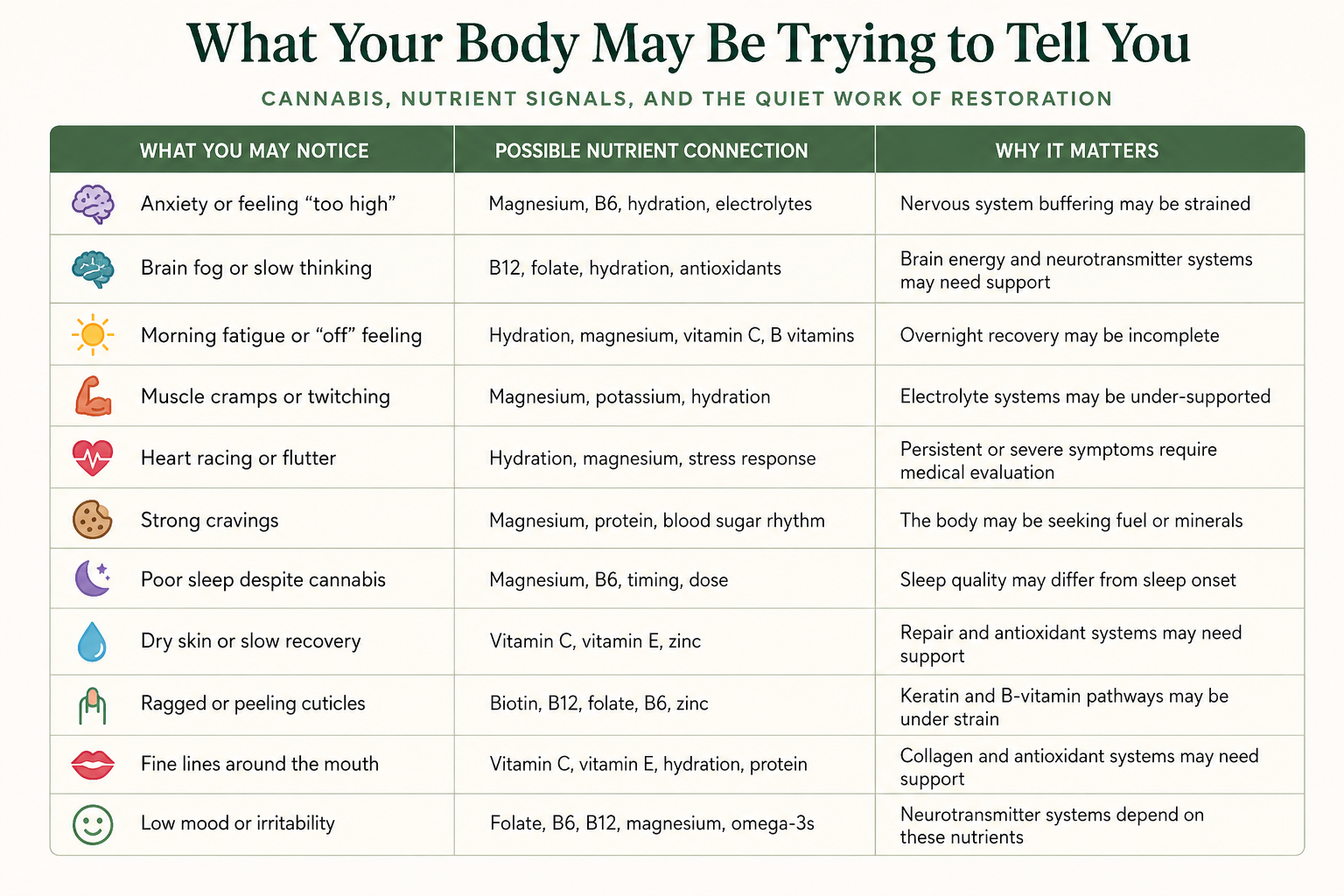
Anxiety or Feeling “Too High”
This is one of the most common experiences people mention quietly. Cannabis can feel calming—but depending on dose, timing, hydration, stress state, and product profile, it can also feel overstimulating or emotionally uncomfortable. That doesn’t automatically mean cannabis is wrong for you. Sometimes it means the body’s buffering systems are already under strain.
Magnesium is especially relevant here. The NIH notes that magnesium supports nerve function, muscle function, blood pressure regulation, glucose control, and protein synthesis.´ Deficiency can progress from fatigue and weakness to muscle cramps, tingling, personality changes, and abnormal heart rhythms.
On an anxious day, a few useful questions: Did I hydrate? Did I eat? Was I already stressed before I used cannabis? Have I had any magnesium-rich foods recently? Often the body isn’t asking for punishment. It’s asking for support.
Brain Fog and Slow Thinking
Vitamin B12 deficiency can contribute to fatigue, weakness, neurological changes, poor memory, confusion, and mood changes.µ Folate and B12 also help regulate homocysteine pathways linked to neurological function.
Some cannabis-related literature has raised questions around elevated homocysteine and low B12/folate status in certain populations.⁶⁷ Those findings aren’t universal—many involve psychiatric or polysubstance-use populations—but they raise questions worth further study.
Morning Fatigue and the “Off” Feeling
Some people wake after cannabis feeling genuinely rested. Others wake heavy, thirsty, mentally dull, or emotionally flat. This may involve hydration, dose timing, sleep architecture, oxidative burden, or inconsistent eating patterns.
Vitamin C supports antioxidant defense and collagen repair.⁸ Smoking cannabis—like smoking anything—increases oxidative load that the body has to process overnight. That burden accumulates quietly.
Muscle Cramps, Twitching, and Tension
Muscle cramps are one of the body’s clearer signals. Magnesium deficiency is associated with cramps, muscle contractions, tingling, and abnormal heart rhythms.´ Cannabis users may also deal with appetite changes, dry mouth, inconsistent hydration, and altered eating schedules—all of which can affect electrolyte balance.
Heart Racing or Flutter Sensations
A racing heart after cannabis may involve THC sensitivity, anxiety, dehydration, electrolyte imbalance, stimulant interactions, or underlying cardiovascular conditions. Persistent, severe, painful, or new symptoms should always be medically evaluated.
From a nutritional standpoint, magnesium and potassium both support normal electrical signaling in the heart and nervous system.´ That doesn’t mean every palpitation is a nutrient issue. But hydration and electrolyte stability matter more than most people realize.
Cravings and Overeating
Cannabis changes food perception—but cravings aren’t always just “the munchies.” Sometimes they reflect unstable blood sugar, dehydration, inadequate protein intake, low magnesium, or stress-related eating patterns. Eating before cannabis rather than after can change the entire experience for some people.
Poor Sleep Despite Cannabis
Cannabis may help some people fall asleep faster. But sleep quality involves depth, REM cycling, nervous system recovery, and metabolic stability. Large doses late at night—combined with dehydration or nutrient strain—may produce sleep that begins easily but restores poorly.
What Your Cuticles May Be Saying
Cuticles and nails depend on keratin synthesis, B vitamins, zinc, and protein status. Biotin (B7), B12, folate, B6, and niacin all contribute.¹¹⁻¹² Ragged cuticles alone aren’t a diagnosis. But when they appear alongside fatigue, brain fog, dull skin, and irritability, the pattern becomes more meaningful.
Fine Lines Around the Mouth
The skin around the mouth is thin, mobile, and particularly vulnerable to oxidative stress. Collagen breakdown accelerates through aging, oxidative burden, and the activation of matrix metalloproteinases. Vitamin C is essential for collagen stabilization and antioxidant defense.¹³⁻¹⁵
Cannabis smoke is not tobacco smoke, but smoke still generates oxidative byproducts that the body must neutralize. That accumulation is slow and easy to miss.
Low Mood or Irritability
Low mood isn’t always psychological in origin. Sometimes it reflects inadequate support for neurotransmitter synthesis, nervous system stability, or recovery pathways. B vitamins, magnesium, omega-3s, and protein all participate in these systems.µ The body can’t build stability from missing raw materials.
Vitamin D—The Quiet Background Nutrient
Vitamin D deficiency can remain hidden for years while affecting muscles, immune regulation, bones, mood, and nervous system function.⁹ A 2022 study found lower vitamin D levels among frequent cannabis users in a Norwegian severe substance-use-disorder population.¹⁰ The population context matters—but vitamin D deficiency is extremely common regardless of cannabis use, and worth paying attention to.
Where to Start
The body responds well to small, consistent improvements. Not overhauls—just incremental changes that reduce the gap between demand and supply.
Four practical starting points:
• Hydrate early in the day
• Eat one magnesium-rich food daily
• Add vitamin C-rich foods most days
• Eat a real meal before cannabis, not after
Then pay attention. Does cannabis feel smoother? Do mornings feel clearer? Does anxiety soften? Does sleep improve? These aren’t diagnoses—they’re observations. And observations, accumulated over time, are how the body teaches you what it needs.
When to Talk to a Clinician
This article is not a substitute for medical care. Talk to a clinician if you experience persistent fatigue, numbness or tingling, chest pain, frequent palpitations, fainting, severe depression or anxiety, unexplained weight loss, or worsening symptoms.
Useful labs may include vitamin D, B12, folate, zinc, magnesium, CBC, CMP, hs-CRP, and homocysteine—depending on your situation and your clinician’s judgment.
A Final Thought
For many people, cannabis was never about rebellion. It was about relief—about calm, about sleep, about slowing the noise of the world long enough to breathe again.
Long before institutions began seriously studying cannabinoids and terpenes, ordinary people were discovering something important through experience: this plant interacts with the human body in meaningful ways. Many learned—largely on their own—how cannabis could help them rest, reconnect, manage discomfort, and restore a sense of balance.
That insight deserves respect. And as the science continues to develop, one thing is becoming clear: the cannabis experience isn’t decided by the plant alone. It’s shaped by the condition of the body receiving it.
When the body is nourished, hydrated, rested, and supported, cannabis tends to feel smoother—more aligned with what people hoped it could be. That’s the core of the Solprana perspective: not restriction or judgment, but support for the systems that support you.
Works Cited
1. Gelfand AR, Tangney CC. “Dietary Quality Differs Among Cannabis Use Groups: Data from NHANES 2005–16.” Public Health Nutrition. 2021.
2. Sarafian TA, et al. “Oxidative Stress Produced by Marijuana Smoke.” American Journal of Respiratory Cell and Molecular Biology. 1999.
3. Emokpae MA, et al. “Marijuana Smoke Inhalation and Potential Micronutrient Deficiencies Among Nigerian Smokers.” Tropical Journal of Phytochemical and Pharmaceutical Sciences. 2025.
4. NIH Office of Dietary Supplements. “Magnesium—Health Professional Fact Sheet.”
5. NIH Office of Dietary Supplements. “Vitamin B12—Health Professional Fact Sheet.”
6. Misiak B, et al. “Elevated Homocysteine Level in First-Episode Schizophrenia Patients Who Abuse Cannabis.” 2014.
7. de Carvalho J, et al. “Management of Hyperhomocysteinemia, Low Vitamin Levels, and Low Cortisol Levels in Cannabis Users.” 2022.
8. NIH Office of Dietary Supplements. “Vitamin C—Health Professional Fact Sheet.”
9. NIH Office of Dietary Supplements. “Vitamin D—Consumer Fact Sheet.”
10. Bemanian M, et al. “Vitamin D Status and Associations with Substance Use Patterns Among People with Severe Substance Use Disorders in Western Norway.” Scientific Reports. 2022.
11. NIH Office of Dietary Supplements. “Biotin—Health Professional Fact Sheet.”
12. Cashman MW, Sloan SB. “Nutrition and Nail Disease.” Clinics in Dermatology. 2010.
13. Iorizzo M, et al. “Nails in Nutritional Deficiencies.” Indian Journal of Dermatology, Venereology and Leprology. 2012.
14. Linus Pauling Institute. “Vitamin C and Collagen Synthesis.”
15. Linus Pauling Institute. “Smoking, Oxidative Stress, and Vitamin C Status.”